
Your Quick Guide to Selling Retail Property in Michigan
If you’re looking to sell retail property Michigan, you’re likely seeking a clear path to move on from property management burdens and open up your investment’s value. Many commercial property owners face similar frustrations: lengthy sales cycles, high commissions, and endless upkeep demands.
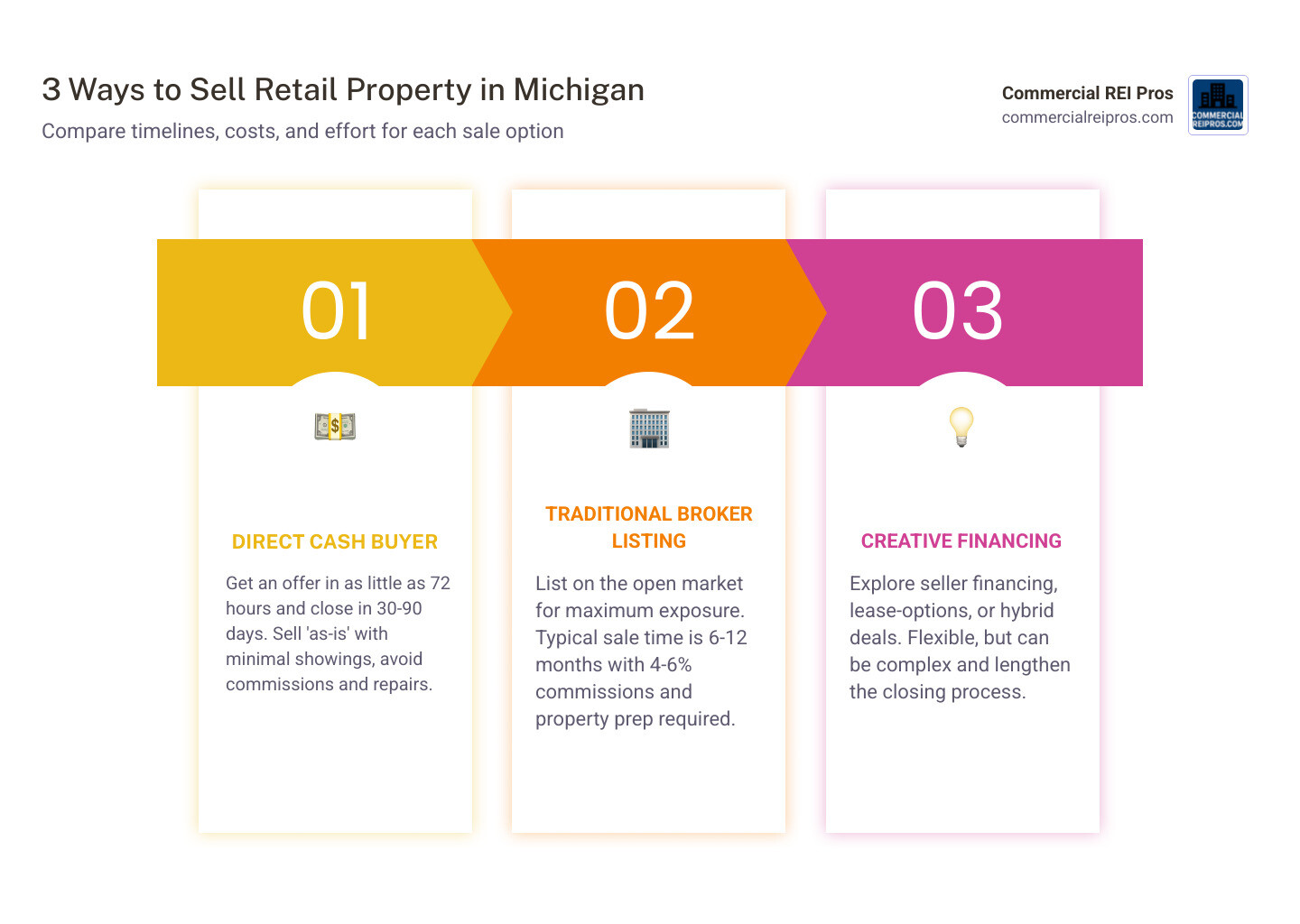
- Selling your retail property in Michigan quickly and hassle-free involves:
- Direct Cash Buyers: Get an offer in 72 hours. Close in 30-90 days with no commissions or closing costs. Sell “as-is” to avoid repairs and showings.
- Traditional Brokers: List on the open market for broader exposure. Expect 4-6% commissions and 6-12 month sale times. Requires property readiness and numerous showings.
- Creative Financing: Explore seller financing or lease-options for specific buyer types, though these add complexity and risk.
This guide offers a step-by-step roadmap to a smooth and successful sale, with practical strategies whether you prioritize speed, maximum value, or both.
This guide is brought to you by HJ Matthews, a commercial real estate investor with over a decade of experience finding undervalued off-market commercial properties.
Understanding Why Owners Decide to Sell
Deciding to sell retail property Michigan is a big step influenced by market conditions, personal circumstances, and strategic planning. You’re not alone – many commercial property owners find themselves weighing their options.
Looking at today’s market, LoopNet shows 342 retail building listings currently available for sale in Michigan. Rising interest rates have made it tougher for buyers to get loans, while e-commerce growth continues changing shopping patterns and affecting foot traffic demand for physical retail spaces.
Many owners have seen vacancy spikes as traditional retailers struggle. The pandemic accelerated these changes, with many businesses closing or shrinking their physical presence. This puts pressure on rental income and property values, making owners rethink their investment plans.
Then there’s tax planning. The timing of your sale can significantly impact how much money you keep, especially with potential changes to capital gains tax and depreciation recapture rules. Personal situations like estate transitions also require turning property into cash.
Deferred maintenance is another factor. As retail properties age, they need significant investment to stay competitive – new HVAC systems, modern storefronts, better parking lots can cost hundreds of thousands. Many owners prefer to sell rather than face these expenses.
Top 6 Motivations to “sell retail property Michigan”
For many, it’s retirement planning. If you bought your retail asset years ago, you might be ready to step back. Managing commercial properties requires active involvement – selling allows you to turn real estate into more liquid, easier-to-manage investments.
Relocation pressures from new jobs, family needs, or lifestyle changes can mean moving away from Michigan. Managing retail property from afar becomes a real headache in this hands-on business.
Sometimes the motivation is foreclosure avoidance. With rising interest rates and potentially declining rental income, some properties face financial pressure. Selling proactively protects credit and potentially saves equity.
Many want equity liberation. If your property’s value has increased significantly in Michigan, you might want to cash in on those gains to diversify your portfolio or find better returns elsewhere.
Tenant management headaches are a huge factor. Retail tenants can be particularly challenging – from tough lease negotiations to constant maintenance requests. Many owners reach a point where they’d rather sell than deal with daily drama.
Finally, entrepreneurial spirits often need capital for new ventures. Selling retail property provides necessary cash to fund new business ideas or investments that might offer greater returns or better align with their passions.
Paths to Sell Retail Property Michigan
When you’re ready to sell retail property Michigan, you have three main paths. Each offers different benefits depending on what matters most – highest price, selling quickly, or finding middle ground.
The traditional listing route gives maximum exposure through MLS and commercial platforms. You’ll attract the most potential buyers but deal with longer timelines, higher costs, and more complexity. Due diligence from buyers can be extensive.
Direct cash buyers flip the script entirely. Instead of waiting months, you can get an offer in days and close in weeks. We purchase “as-is” – no repairs, staging, or endless showings. You might not get the absolute highest price, but you’ll save on commissions and carrying costs.
Creative financing solutions offer flexible middle ground with seller financing, lease-options, or structured payments. These attract buyers who can’t get traditional financing while potentially increasing your return. For details, check our creative financing commercial real estate page.
| Sale Method | Timeline | Costs | Complexity | Net Proceeds |
|---|---|---|---|---|
| Traditional Listing | 6-12 months | 4-6% commission + 2% closing costs | High | Potentially highest |
| Direct Cash Buyer | 30-90 days | <1% closing costs | Low | Moderate to high |
| Creative Financing | 3-6 months | Variable | Moderate | Variable |
Method 1 – List on the Open Market
Traditional route means partnering with a commercial broker to list on MLS. Your broker creates professional marketing materials and gets your property in front of potential buyers through platforms like LoopNet and CoStar.
Traditional brokers in Michigan typically charge 4-6% commission on commercial deals. Add 2% for closing costs, and on a $500,000 property, that’s $30,000-$40,000 in total costs.
Most commercial properties spend 180-360 days on the market. During those months, you’re paying property taxes, insurance, utilities, and maintenance while accommodating numerous showings.
Method 2 – Direct Cash Offer & Close Fast
Direct cash buyers specialize in purchasing retail properties exactly as they are – no repairs, renovations, or headaches.
We evaluate your property within 72 hours and generate a fair cash offer. We don’t get scared off by deferred maintenance, difficult tenants, or unique characteristics that worry traditional buyers.
Once you accept our offer, we can close in 30-90 days. No financing contingencies, lengthy appraisals, or loan approval drama. We handle all closing costs, typically less than 1% of purchase price.
The “as-is” structure is a game-changer. You won’t spend weekends fixing issues or dealing with tenant complaints during showings. We purchase with existing leases and take over all landlord responsibilities at closing.
For details about our process, visit our Commercial Property Cash Offer page.
Method 3 – Hybrid & Creative Financing Solutions
Seller carryback financing means you become the bank for part of the purchase price. The buyer makes a down payment and gives you a promissory note for the balance as monthly payments. This can command premium pricing while providing steady income.
Lease-option agreements let buyers lease with an option to purchase at a set price within a specific timeframe. You get immediate rental income while keeping the door open for future sale.
Note sales involve selling the promissory note to a third party for a lump sum, giving you immediate liquidity while transferring collection risk.
For research on sale-leaseback benefits, visit this comprehensive resource.
Preparing Your Michigan Retail Asset for Market
Proper preparation significantly impacts both sale speed and final price when you sell retail property Michigan. The extent depends on your chosen method, timeline, and financial objectives.
Property valuation considers recent comparable sales, current rental rates, property condition, and local market trends. In Michigan’s market, proximity to major highways, demographics, and e-commerce competition all influence value.
Rent roll cleanup ensures accurate financial reporting. This involves verifying lease terms, confirming tenant payment histories, and documenting pending modifications. Clean financial records expedite due diligence and build buyer confidence.
Environmental assessments identify potential contamination concerns. A Phase I Environmental Site Assessment prevents delays during due diligence, especially for properties near gas stations, dry cleaners, or automotive uses.
Zoning verification confirms current and future uses comply with local regulations. Retail properties sometimes have grandfathered uses that might not conform to current requirements.
Sell “as-is” or Renovate?
This choice depends on your situation and property specifics. When you sell retail property Michigan, this decision significantly impacts timeline and net proceeds.
Repair ROI varies dramatically. Cosmetic updates like paint and landscaping typically provide better returns than major structural improvements, but even cosmetic work can cost tens of thousands and delay your sale by months.
Timeline impact is crucial. Renovations require time to plan, obtain permits, and coordinate contractors. In Michigan’s seasonal climate, exterior work may be limited during winter.
Code compliance issues create unexpected complications. Older retail properties may have grandfathered features that don’t meet current codes. Beginning improvements may require bringing the entire property up to current standards.
We specialize in purchasing retail properties “as-is,” eliminating costly renovations and lengthy preparation. Our value-add experience allows us to see potential others might overlook, often resulting in competitive offers despite current condition.
Due-Diligence Checklist to Avoid Closing Delays
Proper preparation prevents costly delays and failed transactions. Having these items available demonstrates professionalism and expedites closing.
ALTA surveys provide detailed boundary, easement, and encroachment information designed for commercial transactions. These can take 30-45 days to complete.
Title commitment documents reveal liens, encumbrances, or ownership issues. Early review allows time to resolve problems before they become closing obstacles.
Tenant estoppel certificates confirm lease terms directly from tenants, verifying rent amounts, expiration dates, and landlord obligations.
Phase I Environmental Assessments identify potential contamination through records review and visual inspection, preventing delays if environmental concerns arise.
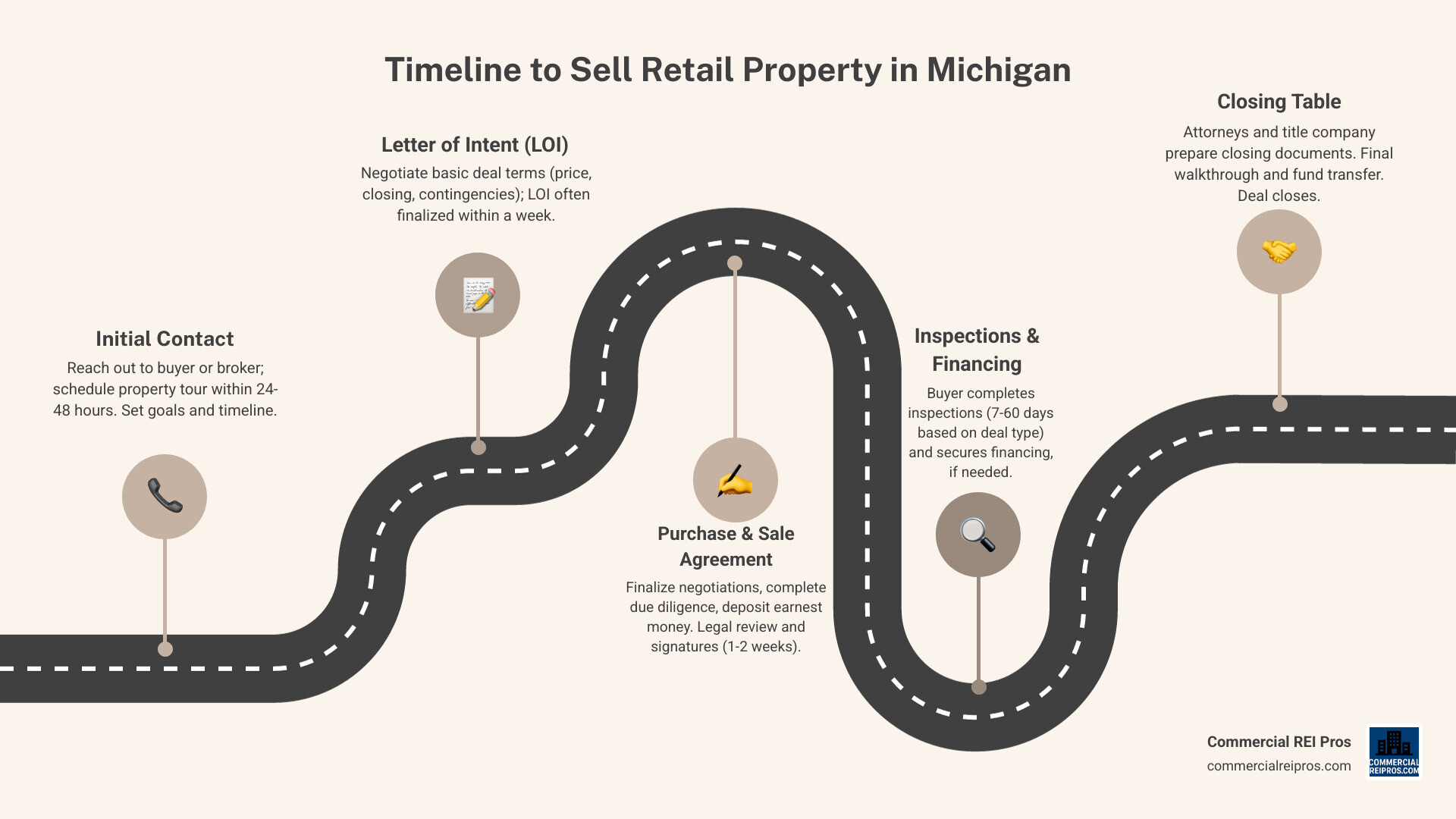
Step-by-Step Timeline: From First Call to Closing Table
Understanding the timeline helps you plan effectively when you sell retail property Michigan. The process varies by sale method, but certain milestones remain consistent.
Initial contact begins the process. This conversation establishes your timeline, identifies objectives, and determines the best approach. We typically schedule property visits within 24-48 hours.
Letter of Intent (LOI) negotiations establish basic transaction terms – purchase price, closing timeline, contingencies, and key terms. While typically non-binding, certain provisions like exclusivity periods may be enforceable.
The Purchase and Sale Agreement creates binding obligations with detailed representations, warranties, and conditions. Negotiating and executing typically takes 1-2 weeks.
Earnest money deposits demonstrate buyer commitment, typically 1-3% of purchase price, held in escrow until closing.
Inspection periods allow buyers to verify property condition. Traditional buyers often require 30-60 days, while cash buyers may complete this in 7-14 days.

Typical 30-Day Fast-Track When You “sell retail property Michigan” to a Cash Buyer
Cash buyers significantly accelerate the timeline. Our streamlined process eliminates traditional delays while maintaining thorough due diligence.
The initial offer process begins within 72 hours of property evaluation. We conduct comprehensive analysis of condition, income potential, and market position. This rapid response is possible because we maintain pre-approved funding.
Limited contingencies reduce transaction failure risk. While we conduct thorough due diligence, our contingencies focus on title issues and major structural problems rather than minor cosmetic concerns.
Flexible closing dates accommodate your specific needs, whether you need to close quickly or prefer to delay for tax planning purposes.
Traditional 6-Month Route & Where Delays Occur
Traditional sales typically require 6-12 months with several common delay points.
The marketing period consumes 3-6 months as your broker attracts qualified buyers. You’ll continue paying all property expenses while accommodating showings.
Lender appraisal processes add 30-60 days once you have an accepted offer. Commercial appraisals require detailed income and expense analysis. If appraisal comes in below contract price, renegotiation may be necessary.
Tenant approvals become necessary if lease terms require landlord consent for sales. Some tenants have rights of first refusal, and obtaining approvals can take weeks or months.
Financial & Legal Implications Every Seller Should Know
Understanding financial and legal implications helps you make smart decisions when you sell retail property Michigan.
Traditional brokers typically charge 4-6% commission on commercial deals – on a $1 million property, that’s $40,000-$60,000. Direct cash buyers eliminate this cost entirely.
Closing costs add another 2% in traditional transactions, including title insurance, attorney fees, and transfer taxes. With cash buyers, these often drop to less than 1%.
Transfer taxes in Michigan vary by location but typically range from 0.75% to 1.1% of sale price.
Capital gains taxation applies to most commercial property sales. Properties held longer than one year qualify for long-term capital gains treatment, with federal rates from 0% to 20%. High earners face an additional 3.8% net investment income tax.
Depreciation recapture often catches sellers off guard. You’ll pay ordinary income tax rates on any depreciation deductions claimed over the years.
Environmental liability can extend beyond closing day. If contamination surfaces later, you could face ongoing obligations depending on sale structure.
For more information, visit our Sell Michigan Retail Building page.
Tax Strategies to Keep More Proceeds
Several legitimate strategies help you keep more money when you sell retail property Michigan.
Installment sales spread capital gains recognition over multiple years by receiving payments over time rather than lump sum at closing. This keeps you in lower tax brackets but involves collection risk.
1031 exchanges offer powerful tax deferral by reinvesting proceeds into similar investment property. You can defer capital gains taxes entirely but must follow strict IRS timelines – identify replacement properties within 45 days and complete exchange within 180 days.
Opportunity Zone investments provide another avenue by investing gains into qualified Opportunity Zone funds. You can defer taxes until 2026 and potentially eliminate taxes on the Opportunity Zone investment appreciation.
Must-Have Legal Documents in Michigan Retail Deals
Proper documentation protects your interests when you sell retail property Michigan.
Listing agreements with brokers need clear terms defining commission structures, marketing obligations, and termination conditions. Pay attention to exclusivity periods and what happens if you find a buyer independently.
Letter of Intent binding clauses require careful review because certain provisions may be enforceable even when the document says “non-binding.” Exclusivity periods and confidentiality requirements often create real legal obligations.
Purchase and Sale Agreement representations and warranties allocate risk between you and the buyer, covering everything from property condition to legal compliance. Overly broad warranties can create ongoing liability after closing.
Commercial real estate transactions involve significant legal complexity. Proper documentation and professional guidance protect you from much larger problems down the road.
Frequently Asked Questions about Selling Retail Property in Michigan
What retail properties are hottest with investors right now?
Investors love properties with strong demographics, highway visibility, and diverse tenant mixes. Strip centers anchored by essential services like grocery stores, pharmacies, and medical offices provide stable income streams.
Properties in Michigan’s booming suburban markets like Ann Arbor, Troy, and Grand Rapids attract significant investor interest due to population growth and higher incomes.
Single-tenant properties with national credit tenants on long-term leases are gold for investors seeking predictable income with minimal management. Value-add opportunities with below-market rents or deferred maintenance appeal to experienced investors seeking to boost returns.
How long will it take to close if I sell “as-is” for cash?
If you sell retail property Michigan “as-is” for cash, you’re looking at 30 to 90 days to close. For urgent situations like foreclosure avoidance, we can often accommodate faster closings.
We aim to provide an initial offer within 72 hours of property evaluation. Once you accept our offer, due diligence including title review, survey, and property inspection typically takes 2 to 3 weeks. Preparing closing documents and coordinating final details takes another 1 to 2 weeks.
Our cash position and experienced team mean no lengthy loan applications or drawn-out appraisal processes.
Do I need to evict tenants before marketing my property?
You almost certainly do not need to evict tenants before marketing. Most investors prefer purchasing properties with existing tenants because it means immediate income and proves the property’s income potential.
If you have problematic tenants consistently late on rent or violating lease terms, addressing those issues before marketing might help you get better pricing.
We purchase properties with existing tenants in place and assume all landlord responsibilities at closing. You don’t need to worry about costly evictions, and we ensure continuity for good tenants.
Conclusion
After reading this guide on how to sell retail property Michigan, you should feel more confident about your options. The right path depends on what matters most to you – highest price, speed, or simplicity.
Key questions to consider: How fast do you want to move? How much do you want to walk away with after fees? How much complexity are you willing to handle?
- Traditional listing might get the highest asking price but means waiting longer, paying hefty commissions, and dealing with property prep.
- Direct cash buyers like us offer speed and simplicity. You can sell “as-is,” skip commissions, and often close much faster with a surprisingly competitive net amount.
- Creative financing solutions offer flexibility for the right situation but require more planning.
At Commercial REI Pros, we’re your one-stop solution for Michigan retail property owners who want to sell quickly and efficiently. Our direct purchase approach means no broker commissions, significantly reduced closing costs, and certainty that’s hard to find in today’s market.
We’re based in Southfield, Michigan, and serve property owners across the state. Whether your property is in Bloomfield Hills, Birmingham, Ann Arbor, Troy, or many other communities, our local market knowledge gives you a real advantage.
Ready to explore your options and get a fair, no-strings-attached offer? Visit our Commercial REI Pros Homepage to learn more. You can also see all the Cities We Buy In across Michigan.
Partner with Commercial REI Pros and confidently turn the page to your next chapter, knowing your property sale was handled with care, professionalism, and ease.